When a ship drawing needs formal class review, the project team has two different conversations to manage. Owners, yards, designers and suppliers may first need to clarify their own drawing questions. The appointed party then submits the required documents through the relevant classification society's process, where the society makes its formal assessment. Confusing those conversations can make a comment, a revised drawing or an approval status difficult to interpret later.
Xenmark helps people review and discuss issued PDF drawings within the project team. It does not act as a classification society, determine which drawings require approval, submit a package for class or issue an approval decision. The responsible designer or engineering party prepares technical revisions; the appointed submitter and society handle the official class exchange.
This page covers four societies and their publicly documented drawing-review systems: DNV, Lloyd's Register (LR), Bureau Veritas (BV), and the American Bureau of Shipping (ABS). It is a guide to the boundary and the official resources, not an assessment of the societies against one another.
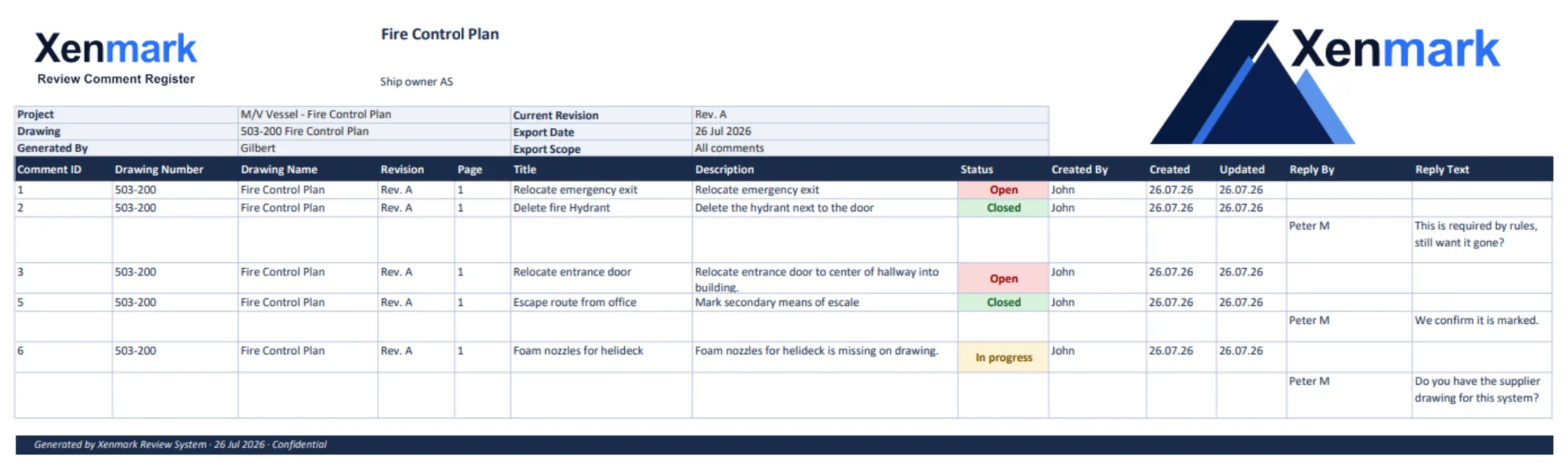
What does a classification society do with ship drawings?
A classification society publishes technical rules and assesses ships against the rules and the applicable project scope. Drawing or plan review can form part of that work, alongside surveys and other checks. ABS explains classification as involving technical review of design plans and surveys. DNV describes plan approval as a review of main drawings for a newbuilding against applicable requirements and its rules. The exact documents and review route depend on the vessel, drawing, class relationship and work being done.
Class and flag responsibilities can also intersect. A society may undertake statutory work when authorized by a flag administration, but a class review and a flag or statutory determination should not be treated as interchangeable labels. The project’s responsible parties need to identify the actual requirement and channel for the vessel. An internal Xenmark comment marked Closed answers neither question by itself.
Where does Xenmark fit in the drawing journey?
| Stage | Who holds the decision or record? | How Xenmark may help |
|---|---|---|
| Internal project review | Owner, yard, designer and other appointed participants record their own observations and decisions. | Discuss exact locations on an issued PDF, collect replies and keep the internal review record. |
| Technical drawing revision | The responsible design or engineering party assesses the input and issues a controlled revision. | Reviewers can check the returned issued PDF against earlier questions. Xenmark does not author the technical revision. |
| Formal class submission and review | The appointed submitter uses the relevant society’s official process. The society manages its own comments, status and decision. | The internal team can prepare a clear handoff, but Xenmark is not the submission or approval channel. |
| Follow-up after a class response | Official class comments and approvals remain in the society’s record. The project team may need a further internal check of an issued revision. | Discuss the returned PDF internally while cross-referencing, not replacing, the official class reference. |
The steps may overlap in a real project, and a particular drawing may take a different route. The useful principle is to preserve who asked the question, who made the technical change and who issued the formal decision. A class-issued comment should remain identifiable as such; an owner-side observation should remain an internal observation until the responsible parties take the next step.
Four official document-review systems
These are the societies profiled here and the resources they publish for drawing or plan review. Product names and access arrangements can change. The applicable project team should use the society’s current instructions and the access granted for its vessel or contract.
DNV
DNV traces its history to 1864, when Norwegian marine insurance clubs established Det Norske Veritas in Oslo to create consistent rules and procedures for assessing vessels. Its first work concerned the condition and seaworthiness of sailing ships. Today, its maritime classification work includes formal drawing and plan approval.
Official document system: eApproval through Veracity. DNV’s plan-approval page describes eApproval in its Veracity portal for uploading documentation, viewing submitted-document status and downloading approved documents. Its document-management help describes drawing lists, document numbers and titles, and revisions. For a DNV project, the appointed party should follow the current DNV route for the relevant vessel and scope. A Xenmark review record can help the project team settle its own points before or after that exchange; it is not a Veracity approval status.
Lloyd’s Register (LR)
LR dates its origin to 1760, when a society connected to Edward Lloyd’s London coffee house began organizing information about ships. Its Register Book helped subscribers understand vessels’ condition, and surveyors became part of the work. LR remains active in maritime classification and design appraisal today.
Official document system: Digital Workbench. LR’s New Construction Digital Workbench describes a design-appraisal path with plan/document upload, status overview, comments, revisions and final deliverables. LR also describes an In-Service Plan Approval application for modification requests and document exchange. The relevant module depends on the project. An internal discussion of an issued PDF should be kept distinct from LR’s own plan-approval comments and deliverables.
Bureau Veritas (BV)
BV began in Antwerp in 1828 as a maritime information service for insurers assessing ships and equipment. It published its first ship register in 1829. Although the wider group now works across industries, ship classification and marine safety remain part of its business.
Official document system: Veristar Project Management. BV’s Veristar Project Management description covers classification project information, drawing references and approval status, approved drawings, and plan-approval comments and replies. Its newbuild classification page describes plan approval as part of the formal newbuild route. Project access and the exact process should come from BV and the appointed project team. An internal Xenmark point does not become a BV plan-approval comment merely because it concerns the same drawing.
American Bureau of Shipping (ABS)
ABS traces its origin to the American Shipmasters’ Association, founded in New York in 1862. That maritime organization was the predecessor of today’s American Bureau of Shipping. ABS now publishes classification rules and provides technical review of ship drawings and documents as part of its classification services.
Official document system: MyFreedom Plan Review. ABS provides MyFreedom Plan Review help covering drawing lists, drawing history, uploads, deliverables and project reports. ABS’s classification overview describes its technical review of submitted drawings and documents. The project’s official ABS record belongs in the ABS process. A separate owner–yard–designer PDF discussion can still be useful when it has a clear drawing number, revision and cross-reference to any formal response.
These systems all handle work within their societies’ processes. The descriptions above identify what each operator publicly documents; they do not establish that the systems have the same features, that Xenmark connects to them, or that one society’s status words apply to another.
What should the project team prepare before the handoff?
Start with the drawing identity: number, title, revision, issue date and the source of the issued PDF. Name the intended package or project scope, the internal reviewers and the questions each was asked to assess. A precise observation should point to a location or tag and distinguish what was seen from what change is proposed. Attach or reference supporting information only where project permissions allow it.
Then record the internal disposition. Which point was answered on the current issue? Which needs a technical revision, a supplier response or an onboard check? Who owns each open question? If an internal comment is Closed, state what that means for the project’s own review; do not let the status imply that the drawing has passed class review. The responsible designer decides how to revise the technical drawing, and the appointed submitter decides what to send through the applicable formal channel under the project’s procedure.
An illustrative handoff might say: “M-104 Rev B was reviewed internally for pump access and equipment location. The owner-side location question was addressed; the supplier service-envelope question remains with the design lead. The appointed submitter will confirm the documents required for the formal submission.” This is an example of internal coordination, not a class-approved package or advice that every project must use this sequence.
If the society later issues an official comment, keep its reference, wording and status in the society’s system. The internal team can cross-reference that identifier while discussing an issued revision, but it should not copy the official decision into an ordinary Xenmark status or describe the internal export as the authoritative class record.
Does every ship drawing need class approval?
There is no single answer for every vessel and document. A drawing’s submission and approval route depends on the applicable rules, vessel and project scope, and on what the responsible parties have agreed or are required to provide. A drawing that the owner wants to keep current is not automatically a class submission; equally, a seemingly small modification may need formal assessment. Ask the project’s designated technical lead and the relevant society when the route is unclear.
An internal review can improve the clarity of the question going into that decision. It cannot determine the requirement by itself. Avoid using a generic “class-ready” label for a file that has only been discussed by the project team.
How do you identify the right official channel?
Confirm which society and project or vessel record applies, who is appointed to submit, what documents are in scope and what access that party has. Use the relevant society’s current instructions rather than assuming that a colleague’s portal view, a previous vessel’s workflow or another society’s terminology applies. If the vessel is undergoing a change of scope or status, the responsible parties should confirm the formal route directly with the society and any other authority involved.
For the internal work before that handoff, see Review Ship Drawings Before Class Submission. For a practical internal worksheet, use How to Prepare a Drawing Review Before Class Submission. Ship Drawing Review & Markup, Vessel Drawing Updates, Newbuild Drawing Review, and Conversion, Refit & Retrofit Drawing Review cover the drawing conversations that may lead to a controlled revision. The global Internal Drawing Review Use Case explains the sector-neutral review pattern.
Related Teams
- Ship Owners — bring operational concerns and the intended outcome into the internal drawing review.
- Shipyards — contribute build or installation context before the formal handoff.
- Marine Engineering Companies — assess technical questions and author controlled drawing revisions within their scope.
- Superintendents / Technical Managers — supply vessel-side observations and evidence when relevant.
The precise project responsibilities vary. Identify the official class submitter and approval route explicitly rather than inferring them from who commented on the PDF.