A fire control plan has to be understood in relation to the vessel it describes. If equipment, access or an onboard arrangement appears different from the latest known plan, the difference should be documented clearly and sent to the party responsible for evaluating and revising the plan.
Xenmark can support that review conversation around an issued plan PDF: place a comment at the relevant location, add supporting context, discuss the point, and examine the returned revision. Xenmark does not revise a fire control plan, determine compliance or provide class, flag or statutory approval.
What might prompt a fire control plan review?
A reviewer may notice that equipment has been moved or replaced, a door or access route differs, or the plan’s location information no longer appears to match the vessel. Those are reasons to raise a question, not universal conclusions about what approval is required. The applicable rules and responsible review route depend on the vessel, the plan and the change.
The IMO-published SOLAS amendment text describes keeping applicable fire-control plans or booklets up to date and recording alterations as soon as practicable. A responsible maritime practitioner should determine how those provisions apply to a particular vessel. The same caution applies to symbols: graphical symbols for the fire control plan follow IMO Resolution A.952(23), supplemented as applicable by IMO Resolution A.1116(30), whose signs are also used as location markings on board. IMO’s fire-protection FAQ sets out which applies from which construction or modification date.
How should an observed difference be marked?
Use the latest known issued plan as the reference. Record the plan number and revision, deck or space, exact drawing location, and what is actually observed. Add a dated photograph, equipment identification or other context if available. Keep separate observations in separate review items so the responsible party can answer and disposition each one.
Illustrative example: A reviewer sees that a firefighting appliance appears at a different location onboard from the location shown on the current plan. The comment identifies the deck and space and asks the responsible party to verify the arrangement and advise on the plan revision. It does not redraw the safety plan, decide the applicable symbol, or assert that a specific approval has already been triggered.
Who prepares and checks the revised plan?
The appointed engineering or design party evaluates the information and prepares the controlled technical revision. The vessel-side team may need to answer questions before that party can determine what to draw. When the revised PDF returns, check the original locations against the new issue and review the affected area for new inconsistencies. Earlier Xenmark comments remain with the revision on which they were raised; the reviewer makes the new-revision judgement.
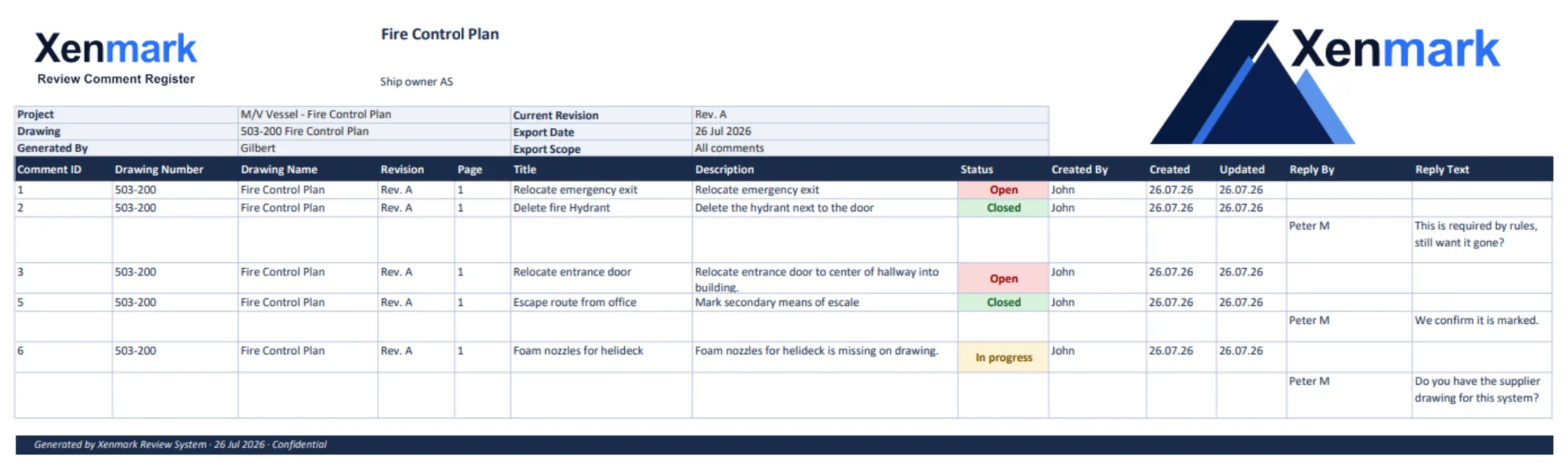
A separate class, flag or other formal process may be required. The responsible parties for the vessel determine that route and submit through the appropriate channel. A Closed review comment in Xenmark means only that the team has closed that review item under its process. It does not mean the plan has been formally approved.
What record can be retained?
Keep the issued plan identity, the observations and supporting evidence, the replies, the returned revision and the team’s review outcome. An annotated PDF and Excel review export can help with handoff. The vessel owner’s controlled document process determines the authoritative onboard plan and archive.
For a step-by-step vessel-side method, read Updating a Ship Fire Control Plan After Onboard Changes. For the wider handoff from onboard discrepancy to revised drawing, read Vessel Drawing Updates.
What should be checked before a discrepancy is sent onward?
First verify that the item in the photograph is the item the reviewer thinks it is. A similar-looking appliance or a photo from the wrong space can create a convincing but incorrect comment. Check the deck, compartment and nearby landmarks against the plan. Note the date and source of the observation. If the issue could involve equipment identification or the applicable symbol, send the question to a qualified person rather than selecting a symbol by appearance alone.
Second, confirm which plan issue the vessel is using. A comment against an old onboard copy may still reveal a real document-control problem, but it should not be presented as proof that the latest controlled issue is wrong. The responsible party needs to know both the observed condition and the provenance of the plan used for comparison.
How should the team handle a disagreement?
Suppose the vessel-side reviewer reports a location difference, while the engineering party believes the plan already reflects the intended arrangement. Keep both statements visible and ask for the evidence that resolves the mismatch: an additional onboard photograph, equipment identification, a recent work record or a clearer plan reference. The answer may be a drawing revision, a correction to which plan is treated as current, or a finding that the original observation identified a different item. Xenmark can organize that exchange, but the conclusion belongs to the responsible people.
This distinction is particularly valuable for fire plans because a casual change to a safety document can have consequences beyond the marked location. Ask and answer precise questions. An unqualified reviewer should not redraw symbols or declare a plan compliant.
How can the record support an audit without becoming an approval?
A review record can show what difference was raised, who supplied evidence, what the plan author replied and which issued revision the team checked. It can help the owner trace the conversation later. It cannot prove that all required equipment is correctly represented, that the plan meets every applicable rule, or that an authority approved it. Those are separate technical and formal determinations.
The cited sources explain specific requirements and terminology; they do not settle every question for a particular vessel. Check the current instrument and ask the responsible plan author, flag administration or classification society which provisions apply. Keep that answer with the vessel’s controlled plan record.
A simplified example of a plan is only an illustration of the review method. Its symbols, equipment positions and layout are not an approved plan for a real vessel. Use the vessel’s controlled plan and the applicable technical guidance for actual work.
Outside sources on this page were checked on 23 September 2026.
Related maritime workflows and guides
Vessel Drawing Updates covers the wider observation-to-revision handoff; Ship Drawing Review & Markup explains shared PDF discussion; Review Ship Drawings Before Class Submission addresses internal review before a separate formal channel. The guide Updating a Ship Fire Control Plan After Onboard Changes gives the step-by-step vessel-side process.
Related Use Cases
Revision Review, Drawing Approval, Drawing Comment Register & Review Deliverables, and Drawing Measurement & Scale Calibration explain the generic review methods and their boundaries.
Related Teams
- Ship Owners — coordinate the owner-side plan question and controlled record.
- Superintendents / Technical Managers — document what differs onboard.
- Marine Engineering Companies — evaluate the evidence and prepare the technical revision.