A ship drawing comment register is useful only when the list can be traced back to the drawing. A response to “Comment 17” means little if the marked PDF shows a different number, the drawing revision is missing, or the owner and yard have separate versions of the list.
Xenmark helps a team keep numbered review comments connected to locations on an issued PDF drawing and to the discussion beneath each point. A matching PDF and Excel export can then provide a portable review record. The register supports coordination; it is not the technical drawing, a class comment letter or formal approval.
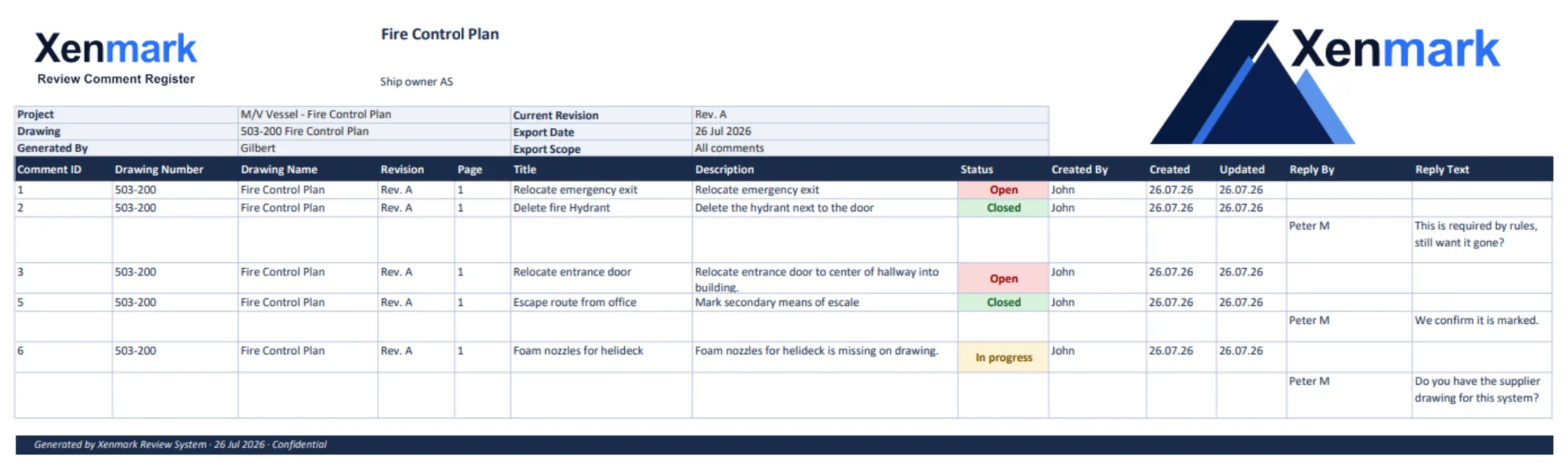
What belongs in a useful ship drawing comment register?
For each point, a reviewer should be able to identify the vessel or project, drawing number and title, drawing revision, sheet or page, exact location, observation or question, who raised it, who is expected to respond, the reply, review status and any later-round outcome note. A tag, deck, compartment or nearby reference can make a dense drawing easier to navigate.
Those fields are a practical review model, not a universal maritime standard. Different projects and clients may require other columns or terminology. The essential principle is that a reader can connect a row to the correct issued drawing and understand the conversation without searching through unrelated emails.
Why should the number on the drawing match the number in the register?
The number is a bridge between visual context and the list. If the PDF has “C-12” beside a valve, the register’s C-12 row should say which drawing issue that location belongs to and what needs answering. Stable identifiers also help the team refer to a point in meetings and transmittals without repeatedly describing the same place.
Illustrative example: On drawing M-104 Rev A, C-12 asks whether the installed valve tag beside pump P-2 matches the drawing. The marine engineer replies that the field photograph is insufficient and requests the nameplate. The owner adds the photograph. The register shows the original question and reply under C-12, while the PDF shows where the question arose. This is a teaching example, not a customer register.
How should later revisions be represented?
Do not erase Rev A from a row simply because Rev B has arrived. The old comment belongs to the issue on which it was raised. The reviewer checks Rev B and records a human conclusion—addressed, partly addressed, unresolved or clarification needed—in a later-round worksheet or note. If Rev B introduces a different concern at the same area, create a new review point on Rev B.
In Xenmark, the review statuses are Open, In progress and Closed. They track the team’s review item, not a ship drawing’s formal approval status. Earlier comments remain on their original revision and are not automatically copied to new geometry.
How can several organizations share the record?
Decide which record is authoritative for the review round. Owner, yard, designer and supplier may each need a portable export, but edited copies should not silently become competing masters. A dated PDF/Excel snapshot helps someone outside the shared review inspect the numbered points. If another party responds through a separate contract or document-control system, record how that response is reconciled with the review.
For a small one-off drawing, a carefully maintained spreadsheet and marked PDF may work well. For repeated comment rounds and several reviewers, keeping location, replies and revision history together can reduce ambiguity. The value is traceability and shared context, not a claim that every project must adopt a particular tool.
Is the register an approval document?
No. It records review observations, questions, answers and the team’s handling of them. The responsible design party authors revisions and the project’s formal channels handle any applicable technical or statutory approval. The vessel owner’s controlled document process determines what becomes authoritative.
The guide How to Maintain a Ship Drawing Comment Register gives a column-by-column method. Redlines vs a Structured Comment Register compares this record with a visual markup using the same issue. The global Drawing Comment Register Use Case covers the generic export workflow.
What should happen before a review round is handed over?
Check that each point has a drawing identity, location, responsible reply and current review status. Separate points that require a technical revision from those that need only clarification. Record which issue of the drawing the exported list represents and whether any related documents remain outside the register. A yard or engineer receiving the export should be able to find C-12 on the stated PDF without asking for a different marked copy.
The register is particularly useful when a newbuild package or vessel-modification project spans several organizations. It does not solve a missing design decision by itself. When two parties disagree, preserve both contributions and route the matter to the person authorized to decide it under the project process.
At the end of a review round, a short summary can group points by drawing and revision, show which questions still need responses, and name the next responsible party. The underlying numbered comments remain the detailed evidence. This makes the export usable for a meeting or transmittal without flattening every issue into one vague “package status”.
Related maritime workflows and guides
Ship Drawing Review & Markup, Vessel Drawing Updates and Newbuild Drawing Review show where the register sits in the wider work. How to Maintain a Ship Drawing Comment Register gives the maintenance method, while Redlines vs a Structured Comment Register compares two ways to communicate the same issue.
Related Use Cases
Drawing Comment Tracking, Drawing Comment Register & Review Deliverables, Revision Review, and Drawing Review Handover & Project Archive explain the sector-neutral mechanics.
Related Teams
- Ship Owners — keep owner questions tied to the issued drawing.
- Shipyards — respond to owner comments across package rounds.
- Marine Engineering Companies — clarify and answer drawing-linked technical points.
- Superintendents / Technical Managers — bring onboard observations into the register.