Before a drawing package enters a formal classification-society process, the project team may need to settle its own questions. An owner representative might query an operational arrangement, a yard might identify an installation interface, and a design lead might need a final clarification from a supplier. Keeping those points tied to the issued drawing can make the internal handoff clearer.
Xenmark is not a classification society. It does not determine compliance, perform class approval, submit a drawing through a society's portal or replace the responsible designer and project document-control process. It can help the internal team review an issued PDF, discuss its own points and check a later revision.
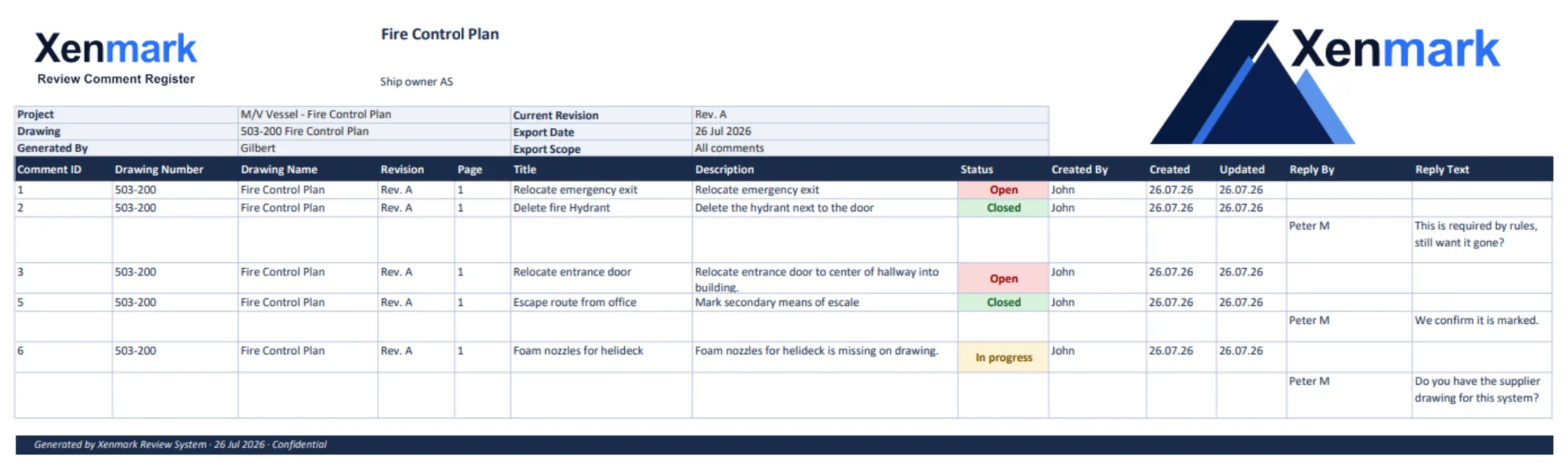
Where does Xenmark fit in the process?
Think of three distinct stages. First, the owner, yard, designer and other appointed parties complete an internal project review. Xenmark can support their comments and replies on an issued drawing PDF. Second, the responsible party submits the appropriate documents through the formal class channel and handles the society’s official review there. Third, if drawings are revised or returned and the project team needs another internal check, Xenmark can support review of that issued PDF.
The stages should not be blended into a single status label. A review item marked Closed in Xenmark records only the project’s handling of that item. It does not mean that a classification society has examined or approved the drawing.
How should internal comments be collected?
Confirm the drawing number, title and revision before the review begins. Ask participants to attach each question to the relevant drawing location and include enough context to answer it: item or area, observation, supporting information, and the decision requested. Keep one issue per point so the design lead can see what is still open.
Illustrative example: On a newbuild machinery arrangement, an owner representative asks whether maintenance access around a pump is represented correctly. A supplier provides an equipment service-space reference. The yard flags an installation constraint. The engineer evaluates the interface and prepares a revised issue if appropriate. The internal discussion may help clarify the package before formal submission, but it is not itself a class review or approved design.
Must every internal point be Closed before submission?
That depends on the project’s own procedure, the point and the responsible decision maker. There is no safe universal rule that every internal comment must be Closed. Some points may require a revised drawing, some may need additional evidence, and some may be deliberately carried with a documented rationale under the project’s process.
Use the review record to make that state visible. Who owns the point? What decision or evidence is outstanding? Which drawing revision does it concern? The team should not hide an unresolved question behind a generic “complete” label, and it should not use a Xenmark status as a proxy for formal class acceptance.
What happens in the formal class channel?
The appointed submitter follows the relevant classification society’s actual procedure. DNV’s plan-approval service is one example; its portal documentation describes formal document numbers and revisions, approval status, comments and replies. Other societies, vessel types and projects can differ. The responsible professionals determine the applicable route and requirements.
Official class comments should remain identifiable as class-issued comments in the formal system. An internal Xenmark comment can help the project discuss how to respond, but it should not be presented as the official class record. Likewise, an internal PDF export is not a stamped drawing or approval letter.
How should a resubmitted or returned revision be reviewed?
Confirm the returned drawing’s number, revision and source. Look back at the team’s internal questions on the earlier issue, then inspect the new PDF. A reviewer judges whether each concern appears addressed and whether the revision introduces any new questions. Earlier comments remain attached to their original revision; Xenmark does not automatically transplant them or decide the outcome.
If an official class comment led to the revision, keep the formal comment and response in the class channel. The project’s internal review can focus on whether the revised issued drawing meets the team’s own agreed needs and whether any interface still requires coordination.
What can the team retain or export?
An annotated PDF and Excel review record can help the owner, yard and engineering company hand over their internal questions and answers. Keep drawing/revision identity and the date of the export. Store the formal submission, class correspondence and approved documents under the appropriate controlled process rather than treating a review export as the final authority.
For a procedural internal worksheet, see How to Prepare a Drawing Review Before Class Submission. For multi-party ship drawing markup, see Ship Drawing Review & Markup. The global Internal Drawing Review Use Case explains the sector-neutral collaboration pattern.
What should the internal handoff actually contain?
Identify the drawings and revisions reviewed, the participants and their scopes, the questions answered, any open internal points and their owners, and the responsible person’s decision about the next step. If a supplier response or another drawing is needed to understand an answer, include its reference. This gives the formal submitter clear project context without representing the Xenmark export as a class-approved document.
Where a formal class comment later prompts a new drawing issue, keep the society’s comment identifier separate from any internal review point number. The internal team can cross-reference the official item and discuss the new PDF, but the official reply and approval status remain in the class system. That separation is practical: a future reviewer should be able to tell who made each judgement and through which process.
An internal review is most useful when it leaves a clear record of scope. If the owner reviewed operational access but not structural calculations, say so. If a supplier answered an equipment envelope question but the yard still needs to assess installation, leave that interface open. State what each party checked and what remains open. A limited PDF discussion cannot establish that the whole design is ready for class submission.
Related maritime workflows and guides
Ship Drawing Review & Markup explains the underlying shared review; Vessel Drawing Updates and Fire Control Plan Review cover relevant project inputs; Newbuild Drawing Review covers package rounds. How to Prepare a Drawing Review Before Class Submission provides the internal worksheet. Ship Classification Societies and Drawing Approval explains the formal systems and the boundary after the internal handoff.
Related Use Cases
Internal Drawing Review, Drawing Approval, Revision Review, and Drawing Comment Register & Review Deliverables explain the generic review and decision boundaries.
Related Teams
- Shipyards — coordinate drawing packages and responses.
- Marine Engineering Companies — resolve technical questions and issue revisions.
- Ship Owners — provide owner-side review and operational context.
- Superintendents / Technical Managers — add vessel-condition evidence where relevant.